


After 16 years on the front lines of the ibogaine field, a closer look at what Trump’s psychedelic executive order accomplishes – and what still needs to happen
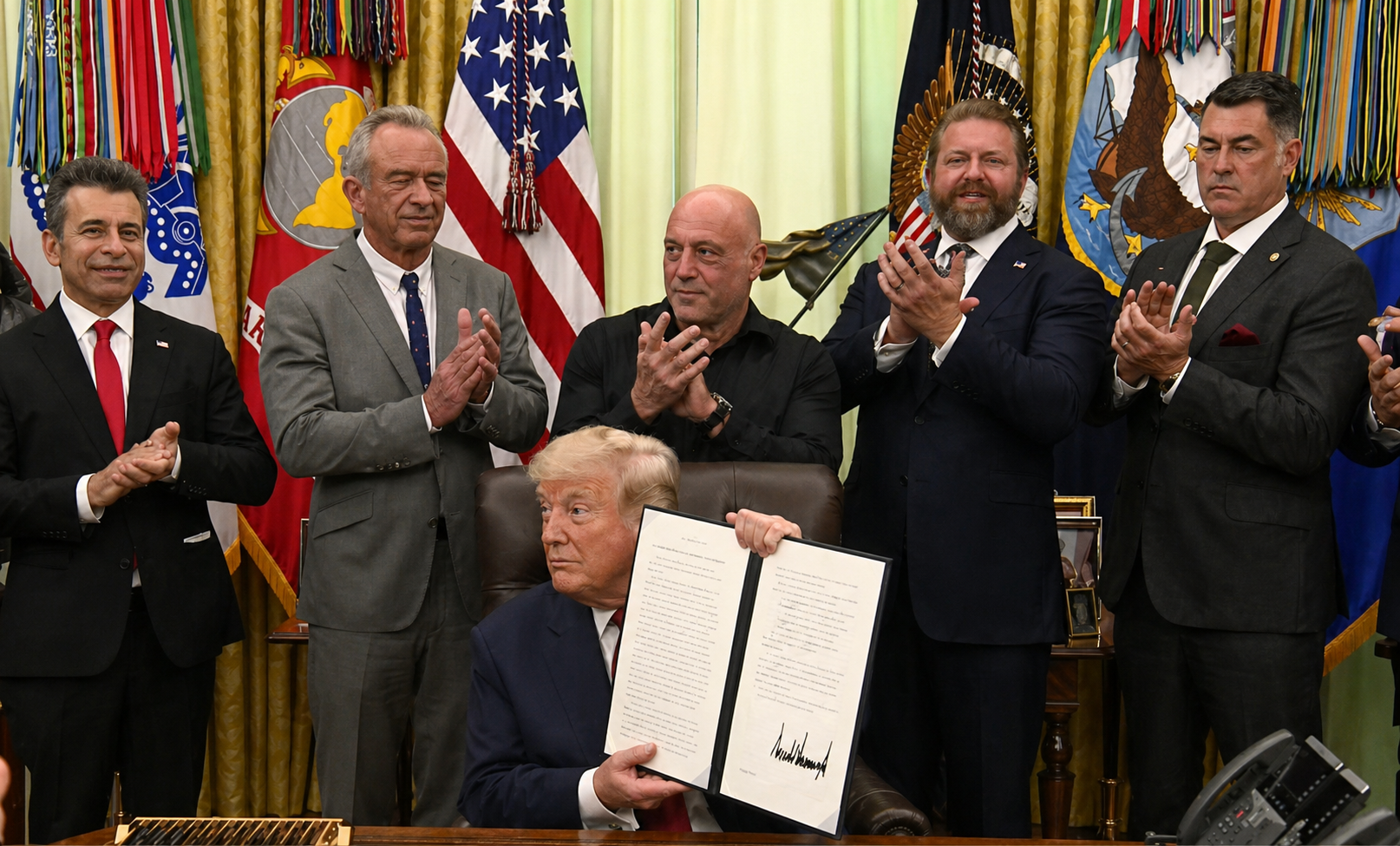
On April 18, 2026 – coincidentally my 40th birthday – a group of my friends and allies stood alongside leadership from HHS and the FDA in the Oval Office, as U.S. President Donald Trump signed an executive order advancing psychedelic research with specific considerations for ibogaine, then turned to ask if he could have some for himself.
After 16 years of working in the field of ibogaine treatment and research, the scene was particularly surreal for me. Trump read statistics from a 2024 Stanford paper that assessed thirty special operations veterans treated at Ambio Life Sciences, a clinic I co-founded and where I serve as CEO. After signing, many of those who spoke shared their experiences of getting treated at our centers in Mexico. It felt like sitting backstage for a show I helped produce, now playing on a global stage.
Unpacking the “80 to 90%” Success Rate
When the announcement came, it was as much a surprise for me as it was for anyone else. Two days before the press conference, someone in D.C. leaked news about the impending order to CBS. Seemingly, it didn’t take much longer than that for Trump to find his position on the issue after receiving a text message from Joe Rogan, citing the massive public health toll of opioid overdoses and claiming that “with one dose of ibogaine, more than 80% of people are free of that addiction. With two doses, it’s more than 90%.”
Trump responded: “Sounds great. Do you want FDA approval? Let’s do it.”
The statistic that Rogan shared was relayed by former Texas Governor Rick Perry during an appearance on the Joe Rogan Experience podcast alongside Bryan Hubbard, the CEO of Americans for Ibogaine. However, the number requires a bit of unpacking. Messages like this, while politically expedient, set up the expectations of patients and families in a way that can be counterproductive for clinicians. For those of us at Ambio providing front-line care to patients – many of whom are navigating addictions – it is our responsibility to discuss possible benefits and risks as accurately as possible.
The “80%” figure most likely originates from a 2017 retrospective study published by Alan K. Davis at Ohio State University, which showcased 88 survey respondents, 80% of whom reported elimination or dramatic reduction of withdrawal symptoms during ibogaine treatment.
Withdrawal is a serious physical challenge, but it is also short-lived and not the primary barrier to long-term abstinence. Many people make it through withdrawal only to find that they struggle with cravings and depression for months or more than a year to follow. The same study showed that about 50% of people found that ibogaine reduced their cravings for at least a week, and 25% reported a reduction in cravings for a month or more.
Altogether, about 30% of interviewees said they remained completely abstinent from opioids for a full year. These are incredible statistics but start to wear down the suggestion that 80% had their addictions wiped clean overnight.
It’s also important to understand that a retrospective study means researchers only collected data from people who responded to an open call. In private correspondence, the researchers confirmed that many former patients remained lost to follow-up, potentially because they didn’t have positive data to report.
There have been several other outcomes studies following ibogaine-assisted detoxification. One 2017 prospective study conducted by Thomas Kinglsey Brown of UCSD, analyzed 30 Americans who received treatment for opioids in Mexico. They found 50% of subjects were abstinent at one month, and 33% at three months. They used a different measurement to report success after one year, which was not based on abstinence, but on general life improvements.
To futher caveat these cases, they involve data collected before fentanyl became nearly ubiquitous in the U.S. illicit drug supply. The Davis paper reached out to patients between 2012-2015 who had been treated even earlier. Fentanyl treatments only began to make up the majority of ibogaine detoxification cases in more recent years, and for various reasons, it has been much more complicated and uncomfortable to treat than heroin or oxycontin, requiring longer in-patient stays and additional medical oversight.
It is important that anyone reporting on outcomes of ibogaine treatment be careful not to inflate already positive statistics, and that we continue to qualify their origin, especially while we’re still dealing with small, limited datasets. One way clinicians temper this tendency is by providing data alongside longer-form stories about the complex physical and emotional recovery journey that surrounds ibogaine. The treatment certainly can smooth out this difficult process, but recovery is not an overnight experience, and there are numerous other aspects of healthcare infrastructure and social support that are critical in the long-term.
I share this not to undermine the conversation that is underway, but because Ambio is patient-facing. As the largest clinic in the world currently providing ibogaine in a medical framework, the narratives and expectations that come through the media affect many of our prospective patients directly. We are not an institutional or government-facing advocacy group, and we have to ensure that our guests can make informed decisions about their health.
What’s Next After the Executive Order
The order itself makes undeniable progress towards reducing technical and procedural barriers that have long complicated psychedelic drug development. It puts several chinks in the edifice that may otherwise keep ibogaine out of the American healthcare system. The strongest way it does this is by sending a strong signal that ibogaine research is a national priority. However, the work to onshore ibogaine treatments to the U.S. is far from over, and it is unclear if much will have changed for ibogaine in a practical sense without addressing some of the remaining challenges.
The FDA Commissioner has been ordered to provide National Priority Vouchers to psychedelic drugs that have received Breakthrough Therapy designations for treating serious mental illness.
To date, Breakthrough designations have been granted to:MAPS (later Lykos, now Resilient Pharmaceuticals) for MDMA to treat PTSD;
Compass Pathways’ COMP360, a synthetic psilocybin, for treatment-resistant depression;
Usona Institute’s psilocybin to treat major depressive disorder;
Definium Therapeutics’ (formerly MindMed) DT120 (formerly MM120), an LSD derivative for generalized anxiety disorder;
AtaiBeckley’s BPL-003, an intranasal 5-MeO-DMT spray for treatment-resistant depression;
Cybin’s CYB003, a psilocybin analogue for major depressive disorder;
Transcend Therapeutics’ TSND-201, a methylone formulation for PTSD.
In fact, less than week later, the FDA followed-up to issue priority vouchers to Compass, Usona, and Transcend. Once their Phase 3 studies are completed and Investigational New Drug (IND) packages are submitted for these drugs, priority vouchers will cut review times from several months to a period of weeks. It is conceivable that an ibogaine product could earn a similar designation in the future, but there are currently no ibogaine products in the IND pipeline.
The Attorney General is ordered to review Schedule 1 drugs as soon as they finish Phase 3 clinical trials, so that they can be rescheduled sooner following FDA approval.
Normally, these reviews are initiated only after FDA approval, so in the future the order will speed up the process of commercializing drugs that are currently on the Schedule 1 list.The FDA and the DEA are ordered to allow “right to try” for psychedelics, including ibogaine.
Typically, the right to try program allows for patients with life threatening conditions to access drugs that have completed Phase 1 safety trials but are not yet approved for use. People qualify who are unlikely survive without interrupting the course of the disease, have exhausted all other treatment options, and are unable to participate in a clinical trial for the drug.
The program historically refers to progressive health conditions that are the primary target of the drug being investigated, so it is unclear whether and how mental health conditions or suicidality would be considered life-threatening in this context. The order essentially dictates that the FDA clarify this potential pathway, and that the DEA refrain from blocking right to try access for psychedelics based solely on their Schedule 1 status.
Although the bill sets out to place ibogaine on the right to try list, no ibogaine product has completed a Phase 1 study in the United States. Atai-Beckley conducted a Phase 1 trial for an ibogaine drug candidate called DMX-1002 in Europe, testing dosages of 3, 6, 9, and 12 milligrams of ibogaine per kilogram of patient body weight (mg/kg) but would have failed to meet the FDA’s cutoff for QT prolongation at 9mg/kg. Theoretically, this could mean that the product would be limited to a dose of 6mg/kg, less than half of what Ambio administers to the general population, and as little as one third of what we use to begin the process of opioid detoxification.
When the FDA has been presented with Phase 1 study outlines more recently, they asked for much more finely tuned dose increments, which could result in a slightly higher upper range. However, it remains to be seen what ibogaine product could be accessed through this program, at what dose it could be administered, and therefore, what life-threatening illness it could be used to treat.Health and Human Services (HHS) is ordered to direct at least $50 million in federal grants towards states that have requisitioned funds to evaluate psychedelics as mental health treatments.
This dovetails with recent announcements in Texas that extend the state’s support for ibogaine clinical trials from $50 to $100 million, as well as announcements from other states that are forming a patchwork of other laws to requisition smaller amounts.
Yet, the same programs have struggled to attract private sector investment that may still be required to complete financing for the development. The original $50-million commitment in Texas was intended as a matching grant to be shared with a private firm willing to grant Texas a 20% share of its revenues, plus additional royalty payments. Normal patent royalties that provide developers with long periods of market exclusivity are not nearly so onerous, so that means that any company accepting the funding would have been saddled with an unrealistic downstream cost.
Compounding matters further, drug development goes in stages and fundraising is usually tied to major milestones that de-risk larger investments as drugs move forward. Accepting a $100 million injection creates a substantial liability for an early-stage developer who hasn’t already posted strong early phase results. In the absence of interest from private firms, $50 million from HHS will help inch the project forward, but far from cover the full price-tag.
If opioid addiction will be a central focus for research in the U.S. and “right to try” access, other policies will need to be amended to allow for the prescription of short-acting opioids. At Ambio, when patients arrive for opioid detoxification, we begin by administering morphine sulphate for several days -- or in the case of fentanyl now more than 14 days. This helps to stabilize the body and fluctuations in opioid use, resulting in a simpler and smoother process when ibogaine is introduced. Stabilization is an essential safety measure, and it’s probably better to call ibogaine detoxification a combination ibogaine-morphine treatment.
Unfortunately, the use of morphine for this purpose would be prohibited in the U.S. by the restrictions designed to prevent the resurgence of oxycontin overprescription. Other protocols exist to use ibogaine in a way that gradually weens people off long-acting opioid maintenance drugs like Methadone and Suboxone, but the FDA has strict prohibitions about taking people off these stabilizing medications because of a non-trivial increase in overdose risk.
Very much at the beginning of their journey to wrestle with these technical nuances, some federal agencies seem to have gotten the memo that ibogaine is now a priority. Within just a few days, I spoke to representatives from the Advanced Research Projects Agency for Health (ARPA-H) EVIDENT program inquiring about Ambio’s real world data from over 3,500 treatments, many of whom were veterans with mild traumatic brain injuries (mTBI).
This was a promising sign, acknowledging that ibogaine and the results that are being discussed on the national stage did not appear in a vacuum. In my forthcoming book, Ibogaine and the Bicameral Mind, I detail a long history of iboga and ibogaine’s traditional and clinical uses, and what has been learned outside of institutional healthcare systems. As this momentum accelerates in the U.S., institutions, regulators, and advocates must engage with decades of real-world experience from Ambio and other established clinics that have refined a variety of specialized treatment protocols for various conditions.
There is also much to say about the relationship between ibogaine and Gabon, the homeland of iboga and the cultural source of knowledge about ibogaine’s healing potential stretching back centuries. There are legal and ethical considerations that may emerge, both as opportunities and liabilities for the U.S. and state researchers to respond to. As a Bwiti initiate and a holder of a Nagoya-compliant export license from Gabon, I have some perspective on these issues. However, this topic will need its own analysis, and it will be better to wait and understand Gabon’s reaction to the news from the U.S. first.
